

When your baby is sleeping upstairs, and you’re downstairs making dinner, folding laundry, or finally sitting down for five quiet minutes, it’s completely normal to want to check in without running up the stairs every time you hear a sound.
That’s where choosing the right baby monitor for a two-storey house really matters. Not because you need more tech, but because a reliable connection across floors can make everyday life feel calmer and more manageable.
This guide is here to help you understand what actually makes a baby monitor work well in a two-storey house, without turning it into a stress spiral or a race for the most expensive option.
Why range matters in a two-storey house

In a two-storey house, the challenge isn’t just distance. It’s what sits between the baby monitor camera and the parent unit.
Floors, ceilings, walls, staircases, ducting, and even thick insulation can weaken a signal. A baby monitor that works perfectly in a single-level home can struggle once you add vertical distance.
That’s why range is such an important factor when choosing a baby monitor for a two-storey house. You’re not looking for the biggest number on the box. You’re looking for a monitor that can hold a steady connection through multiple floors, without dropouts that make you second-guess every crackle.
Understanding range specifications: open field vs real world
One of the most confusing parts of buying a baby monitor is range specifications.
Most baby monitors list an “open field” range, usually somewhere between 200 and 550 metres. This number is measured under ideal conditions, with no walls, floors, or interference. Real homes are very different.
In a two-storey house, the open-field range typically translates to approximately 45–90 metres of real-world indoor range, depending on construction materials and layout.
That doesn’t mean those numbers are misleading. It just means they need context. When choosing a long-range baby monitor, higher open field numbers generally indicate better performance across floors, but they’re only part of the picture.
WiFi vs non-WiFi baby monitors for multiple floors
One of the biggest decisions when choosing a baby monitor for a two-storey house is whether to go with a WiFi or non-WiFi model.
WiFi baby monitors

WiFi baby monitors connect through your home internet. Instead of relying on the distance between the camera and a parent unit, they send video and audio through your network.
For two-storey houses, this can be a big advantage. As long as your WiFi signal is strong upstairs and downstairs, range limitations are mostly removed.
WiFi baby monitors also allow you to check in via your phone, which some parents find reassuring, especially if you move around a lot or spend time outside.
The trade-off is that WiFi monitors depend on internet stability. If your connection drops or your router struggles with thick walls, performance can be affected.
WiFi options within our Be Friends collective
-
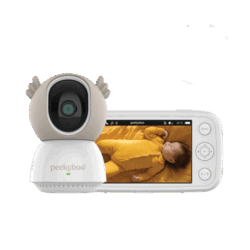
- Peekyboo Baby Monitor

-
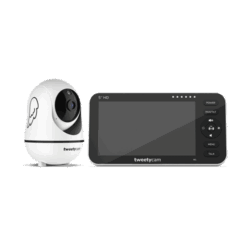
- Tweetycam Baby Monitor

-
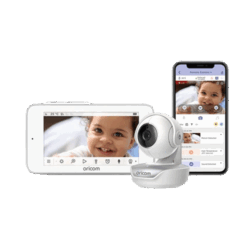
- Oricom OBH36

Non-WiFi baby monitors

Non-WiFi baby monitors use dedicated signals such as FHSS or DECT. These monitors communicate directly between the camera and parent unit, without going through the internet.
For many two-storey houses, non-WiFi baby monitors perform extremely well because their signals often penetrate walls and floors more reliably. They’re also appealing if you want something simple, self-contained, and not reliant on internet bandwidth.
The main limitation is physical range. Even the best non-WiFi baby monitor will eventually reach its limit in larger or more complex homes.
There isn’t a right or wrong choice here. The best baby monitor for a two-storey house is the one that works with your home layout and how you like to check in.
Non-WiFi options within our Be Friends collective
-
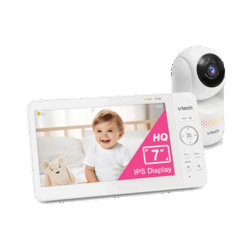
-
VTECH
Performance HQ Max 7
View Brand

-
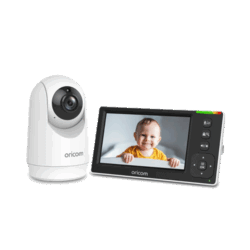
-
ORICOM
SC430 4.3″ Video Monitor
View Brand

Signal strength through multiple floors
Signal strength across floors is affected by more than just distance.
Concrete slabs, metal framing, underfloor heating, and even large appliances can interfere with a baby monitor signal. This is why two houses with the same floor plan can have very different results with the same baby monitor.
If you’re choosing a non-WiFi baby monitor for a two-storey house, look for models known for strong multi-floor performance and long-range capability. If you’re choosing WiFi, consider whether your router reaches the baby’s room reliably.
Testing matters. Even the best baby monitor should be tested in your actual home, upstairs and downstairs, during naps and overnight.
Essential features for multi-floor monitoring

When using a baby monitor across multiple floors, a few features tend to matter more in everyday life.
Video baby monitor capability is important when your baby is out of earshot. Being able to glance at the screen rather than relying on sound alone can be reassuring.
Night vision is essential and now standard, but image clarity varies. A clear night view makes it easier to check breathing and movement without guessing.
Two-way audio can be helpful if your baby settles when they hear your voice, especially when you’re downstairs and don’t want to rush up straight away.
Battery life matters more than you might expect. A parent unit that lasts through naps and bedtime without constant charging is one less thing to manage.
If you’re monitoring more than one child, split screen and multi-camera support allow you to keep an eye on different rooms on different floors without juggling devices.

Choosing what works for your home
There’s no single best baby monitor for every two-storey house.
Some homes perform best with a Wi-Fi baby monitor that eliminates range issues. Others work well with a non-WiFi baby monitor that offers strong, long-range performance and reliable signal strength through floors.
The best choice is the one that helps you relax a little more, knowing you can check in when you need to. Baby monitors are there to support you, not to keep you on high alert or make you feel like you need to watch constantly.
If you’re unsure, this is exactly the kind of question other mums talk through inside Facebook groups every day. Different houses, different layouts, different experiences. Hearing what worked for someone in a similar setup can be incredibly grounding.
You don’t need perfect coverage. You just need something that works reliably in your two-storey house, so you can get on with the rest of your day feeling a little more at ease.
If you’re still weighing up a few options, the worksheet can help you compare them side by side at your own pace.